For practitioners

Daily nutrition for the kids you see every dayin the water bottle they already carry.

Mac and cheese three nights running.
Fruit and vegetables get negotiated, not eaten.
The water bottle is the only thing that comes back empty.
Laughing child in a yellow sweatshirt
17Vitamins & minerals
11Nutrients with AAT™ liposomal delivery
3gPrebiotic fiber blend
0gAdded sugars

The vegetables didn’t happen. The nutrition still does — in the water bottle they already carry.

3 g prebiotic fiber blend, 17 vitamins and minerals — 11 liposomal, 4 (A, D, E and K) in a self-nanoemulsifying drug delivery system (SNEDDS) — and 0 g sugar.

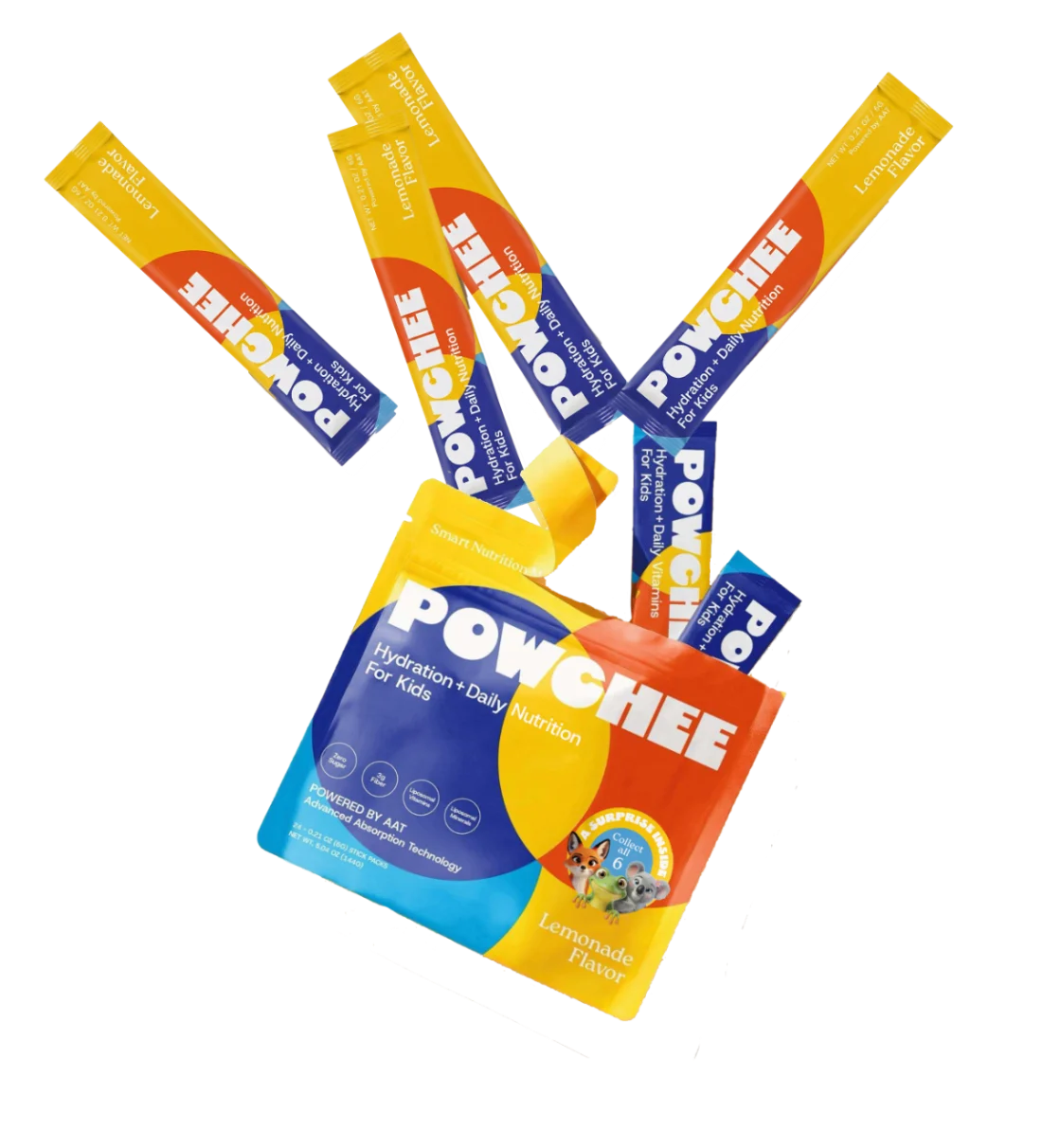
POWCHEE Lemonade pouch with stick packs
Where it goesThe water bottle they already carry.
The gap it closesNuggets, crackers, two bites of broccoli. 95% of kids fall short on fiber, and 62% of their calories come from ultra-processed food.*
What changesA daily floor instead of a guess — twelve nutrients at 20% DV, plus 3 g fiber.

* Fiber: NHANES, ~95% of US adults and children below the Adequate Intake (Am J Lifestyle Med 2017). Ultra-processed calories: CDC/NCHS Data Brief 536, ages 1–18, 2021–23. Full bibliography ↓

Who can join the Practitioners Program?

Check if you qualify
  • Pediatricians
  • Nurse practitioners
  • Registered dietitians & nutritionists
  • Pediatric dentists
  • Chiropractors
  • Naturopathic doctors
  • Holistic health practitioners
  • Health coaches & child wellness advocates
  • Other pediatric specialists

Two products.
Two jobs.

Pick one or both.

Will this child drink a flavored drink?
Yes — goes in the water
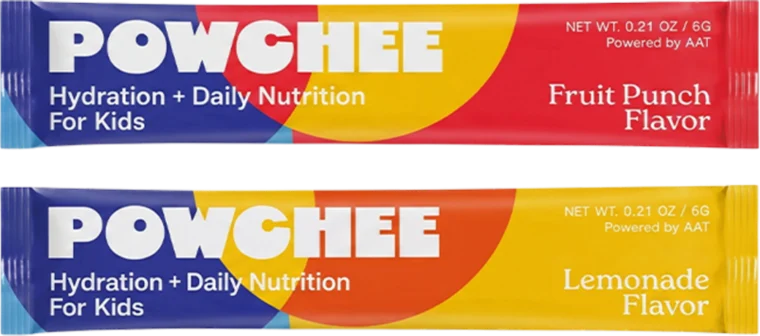
POWCHEE Lemonade and Fruit Punch stick packs

Lemonade & Fruit Punch

One 6.7 g stick into cold water. For the kid who won’t drink plain water.

  • 17 vitamins & minerals — 11 with liposomal delivery
  • 3 g dual prebiotic fiber
  • Soluble calcium 130 mg · potassium 80 mg
Nutrition FactsPer 1 stick
Lemonade1 stick · 6.7 gFruit Punch1 stick · 6.7 g
Amt%DVAmt%DV
Calories1010
Total Fat0g0%0%0g0%0%
Sodium80mg5%3%80mg5%3%
Total Carbohydrate4g3%1%3g2%1%
Dietary Fiber3g21%11%3g21%11%
Added Sugars0g0%0%0g0%0%
Vitamin D4mcg25%20%4mcg25%20%
Calcium130mg20%10%130mg20%10%
Potassium80mg2%2%80mg2%2%
Vitamin A (RAE)180mcg60%20%180mcg60%20%
Vitamin C18mg120%20%18mg120%20%
Vitamin E3mg50%20%3mg50%20%
Vitamin K24mcg80%20%24mcg80%20%
Thiamin0.24mg50%20%0.24mg50%20%
Niacin0.8mg15%6%0.8mg15%6%
Vitamin B60.34mg70%20%0.34mg70%20%
Folate (DFE)80mcg55%20%80mcg55%20%
Vitamin B120.48mcg55%20%0.48mcg55%20%
Biotin6mcg75%20%6mcg75%20%
Pantothenic Acid1mg50%20%1mg50%20%
Iodine30mcg35%20%30mcg35%20%
Zinc1.1mg35%10%1.1mg35%10%
Selenium2.75mcg15%6%2.75mcg15%6%
0 g sat. fat, trans fat, protein & sugars; 0 mg cholesterol & iron. Full label: Lemonade · Fruit Punch
No — goes in the food
POWCHEE Power Pack flavorless 1 g stick

Power Pack (flavorless)

One 1 g stick into any food or drink. For the kid who won’t drink it at all.

  • 15 vitamins & minerals — 11 with liposomal delivery
  • Tear open and stir into mac and cheese, yogurt, ranch or juice
  • No taste, no color, no grit
Nutrition FactsPer 1 stick
Power Pack1 stick · 1 g
Amt%DV
Calories0
Total Fat0g0%0%
Sodium0mg0%0%
Total Carbohydrate1g1%<1%
Dietary Fiber<1g6%3%
Added Sugars0g0%0%
Vitamin D4mcg25%20%
Calcium0mg0%0%
Potassium0mg0%0%
Vitamin A (RAE)180mcg60%20%
Vitamin C18mg120%20%
Vitamin E3mg50%20%
Vitamin K24mcg80%20%
Thiamin0.24mg50%20%
Niacin0.8mg15%6%
Vitamin B60.34mg70%20%
Folate (DFE)80mcg55%20%
Vitamin B120.48mcg55%20%
Biotin6mcg75%20%
Pantothenic Acid1mg50%20%
Iodine30mcg35%20%
Zinc1.1mg35%10%
Selenium2.75mcg15%6%
0 g sat. fat, trans fat, protein & sugars; 0 mg cholesterol & iron. Full label: Power Pack
Both11 liposomal + 4 SNEDDS nutrients0 g added sugar, no dyes20-stick pouch

Flavorless is a formulation property, not a hiding place. We tell parents to tell the kid — “this is your POWCHEE, it goes in your mac and cheese” — because food trust is worth more than a gram of powder.

Protected delivery,
powered by Advanced Absorption Technology (AAT™).

Advanced Absorption Technology (AAT™) is our name for two protected delivery systems — liposomal and SNEDDS.

Most kids' mixes dose high and hope enough gets through. Ours works differently: a liposomal premix carries the 11 water-soluble vitamins and minerals, and SNEDDS carries the fat-soluble A·D·E·K. Both are built to protect the nutrient and support absorption — which is why we dose conservatively. That’s a property of the ingredients, not a study of POWCHEE.

What is a liposome?
1 2 3 4 Phospholipid shell A continuous phospholipid membrane Polar phosphate head Hydrophilic · faces the water Fatty-acid tails Hydrophobic · the lipid interior Aqueous core Where the vitamins and minerals ride
  • 1
    Phospholipid shellA continuous phospholipid membrane
  • 2
    Polar phosphate headHydrophilic · faces the water
  • 3
    Fatty-acid tailsHydrophobic · the lipid interior
  • 4
    Aqueous coreWhere the vitamins and minerals ride
About this illustration

A schematic of a liposome: a phospholipid shell around a water core that carries the 11 water-soluble vitamins and minerals. Our supplier manufactures and characterizes this premix as liposomal. Vitamins A·D·E·K travel separately in SNEDDS — an oil-and-surfactant system built for fat-soluble nutrients.

What is SNEDDS?

Self-Nanoemulsifying Drug Delivery System. Vitamins A, D, E and K dissolve in oil, not water, so a liposome’s water core can’t carry them. SNEDDS holds them in a dry oil-and-surfactant matrix instead; in the gut it self-assembles into nanoemulsion droplets typically under 100 nm, designed to be absorbed without relying on dietary fat.

Different structure, same two jobs as the liposomal premix: protect the vitamin and support its absorption. Used only for the A·D·E·K fraction. The human evidence for this class comes from neighbouring lipid formats (self-emulsifying, micellar, microemulsion); SNEDDS-specific vitamin data are preclinical. See the bibliography.

Why the dose is 20%, and where the evidence stops

Why the dose is 20%, not 100%

Legacy kids' vitamins dose to 100% DV on the assumption absorption is poor. Published PK work on this class of delivery generally shows the largest differences at lower doses — so we put a floor under a day's intake instead of a megadose. Two sticks stays under every upper limit, including the ages 1–3 column.

Where the evidence stops

In short-term human PK studies, liposomal vitamin C reached higher plasma concentrations than non-liposomal, with wide variation. Whether that is retained rather than excreted hasn't been characterized, whether it produces clinical benefit hasn't been established, and none of it was generated in children. For the SNEDDS fraction we found no human study of A, D, E or K in a self-nanoemulsifying system — the human data are for related lipid formats, and the SNEDDS-specific data are in animals.

POWCHEE has not been clinically studied. Every reference on this page supports an ingredient or a delivery technology — not the finished product. If you find a claim here our file doesn't support, tell us and we'll change the page.

Learn more about the POWCHEE Practitioners Program — how your practice code works, and what we verify.

See how enrollment works

How POWCHEE compares

Nutrition figures are published label values — theirs and ours.

Swipe to compare →
Per serving POWCHEE Hydration
sticksLeading brands in the category
Multi­vitaminsLeading brands in the category
Added sugar0 gUp to 6 gUp to 5 g
Prebiotic fiber3 g0 g0 g
Vitamins & minerals178 or fewer9–15+
Calcium10% DVNoneOften none
Liposomal delivery11 of 17NoNo
SNEDDS delivery (A·D·E·K)4 of 17NoNo
Goes in the bottle they already carryYesYesNo
No pill, gummy or chewableYesYesNo
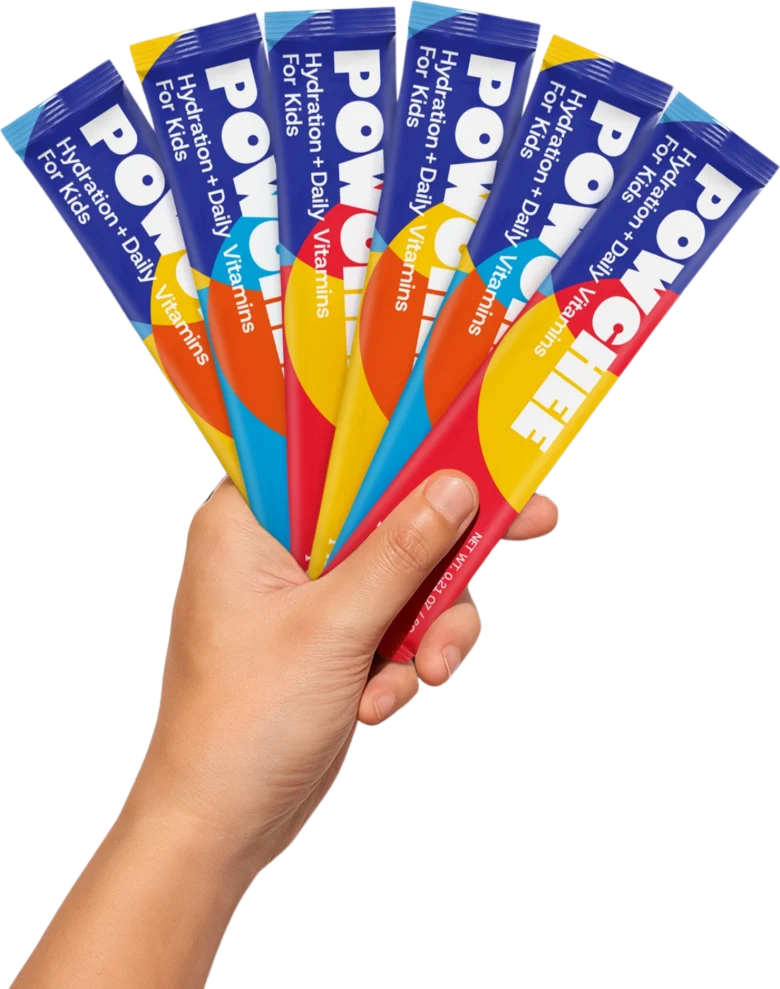
A hand holding a fan of POWCHEE stick packs

Five jobs.Every ingredient earns one.

Every ingredient is there to do one of five things. Open the ones you care about — skip the rest.

Vitamins & minerals

17 vitamins and minerals — 12 at 20% DV, 5 declared lower (ages 4+ values).

  • 11 liposomal — C, the B’s, zinc, selenium, iodine
  • 4 SNEDDS — A, D, E, K
  • Calcium — fully soluble; supplier adult data comparable to milk calcium
Per flavored stickAmount%DV 4+
Vitamin A180 mcg RAE20%
Vitamin C18 mg20%
Vitamin D4 mcg20%
Vitamin E3 mg20%
Vitamin K24 mcg20%
Thiamin (B1)0.24 mg20%
Vitamin B60.34 mg20%
Folate80 mcg DFE20%
Vitamin B120.48 mcg20%
Biotin6 mcg20%
Pantothenic acid (B5)1 mg20%
Iodine30 mcg20%
Calcium130 mg10%
Zinc1.1 mg10%
Niacin (B3)0.8 mg6%
Selenium2.75 mcg6%
Potassium80 mg2%
Iron0 mg0%

%DV against the FDA ages 4+ reference values. The Power Pack carries the same vitamin blend without calcium and potassium. The printed panel on your shipment is the controlling document.

Prebiotic fiber

3 g per flavored stick, from two fibers rather than one: partially hydrolyzed guar fiber (PHGG), which has published pediatric clinical data, and a cassava-root soluble fiber. Both are low‑FODMAP, slow‑fermenting soluble fibers chosen for tolerability — PHGG has published randomized trials in children. Roughly a quarter of a school-age child's daily target.

Zero sugar

The panel reads 0 g total sugars and 0 g added sugars. Sweetened with a Reb A and Reb M stevia blend at the lowest workable level — no aspartame, sucralose or acesulfame‑K, no maltodextrin. A full stick is 10 calories.

Soluble calcium

In the supplier’s adult bioavailability study, POWCHEE’s calcium salt absorbed comparably to milk calcium — about 32% fractional absorption versus about 30% for milk, with or without a meal. That study is unpublished and adult-only; we don’t convert it into a claim about children. Why it matters: a school-day drink is sipped between classes, not with lunch. It’s a calcium lactate and gluconate blend, declared on the panel as exactly that, and it fully dissolves in cold water with no chalky taste. 130 mg per flavored stick, 10% DV — a nutrient most hydration sticks and many kids’ multivitamins leave out.

No synthetic dyes

No FD&C colors in any SKU — no Red 40, no Yellow 5, no Blue 1. Only Fruit Punch is colored, and only with plant-derived, natural colors. Lemonade and the Power Pack have no added color at all — which is exactly what lets the Power Pack disappear into a food a picky eater already accepts.

What we leave out.

None of the nine major allergens are used as an ingredient in any POWCHEE SKU. All three SKUs test gluten-free on finished product.

Not used as an ingredient
MilkEggFishCrustacean shellfishTree nutsPeanutsWheatSoybeansSesame
Also not added
Artificial sweetenersSynthetic dyesIronMelatoninAdded sugars
Gluten-free · tested

Not detected in finished product, all three SKUs — ELISA, ISO/IEC 17025-accredited lab.

View certificate:

Everything you need, shipped free.

A starter box for your office, sent the week your credentials clear.
1
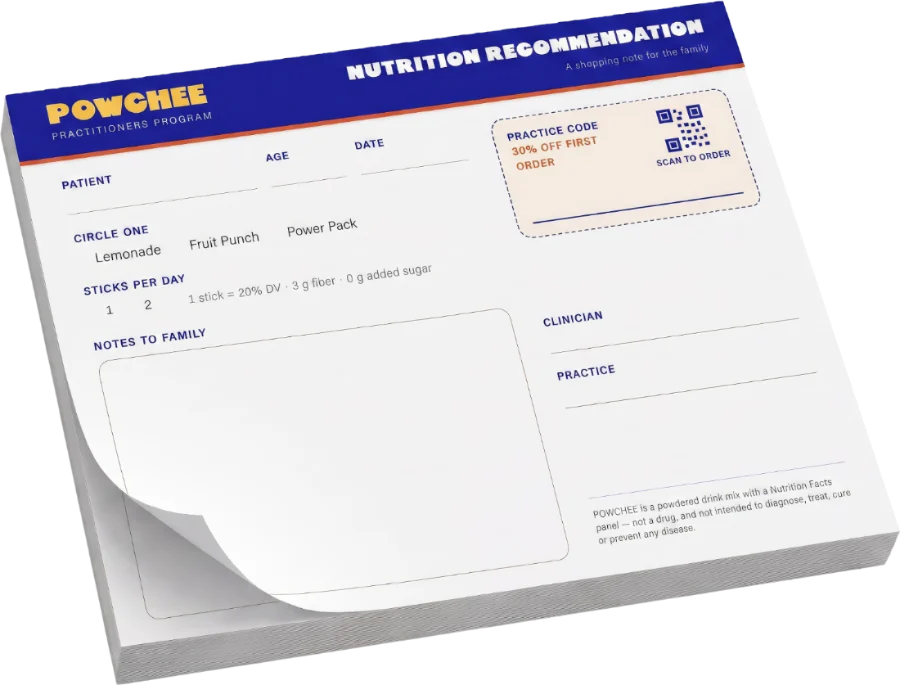
POWCHEE nutrition recommendation pad, 5.5 by 4.25 inches
Recommendation pads Goes home with your practice discount code.
2
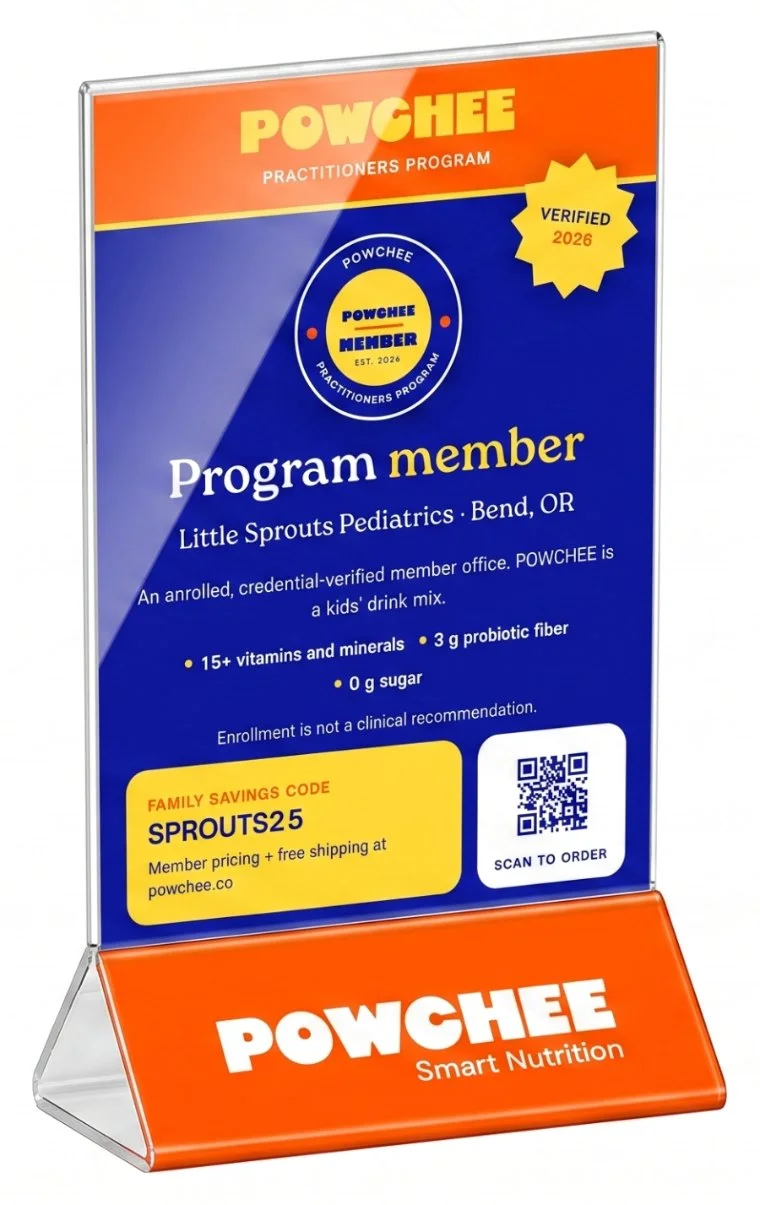
POWCHEE countertop card in an acrylic stand, 4 by 6 inches
Countertop card & stand Your member seal — practice name and code, printed, for the front desk.
3
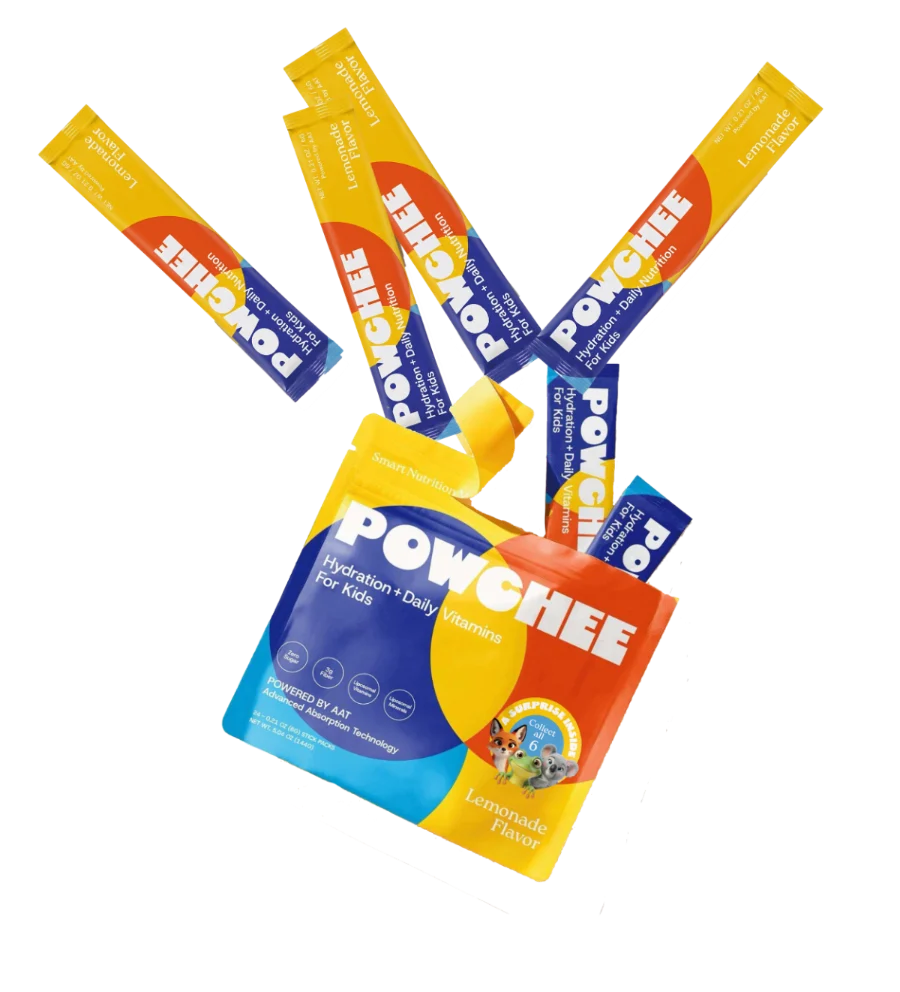
POWCHEE pouch with loose stick packs
40 sample sticks Pass them out to families.
Claim your starter box One box per practice · free shipping

Two ways to enroll. Pick the one your practice allows.

Where the disclosure obligation actually sits — read in full

Public endorsements are ours to police. The FTC Endorsement Guides (16 CFR 255) govern advertising — a quote, a photo, a testimonial, an “as recommended by.” Commission is a material connection, and it has to be disclosed clearly and conspicuously. So we don't publish your name, quote or photo without written approval each time, and any public material we run carries the disclosure. You don't have to draft it.

In the room, your own rules are the ones that bite. Handing a family a sample and a savings code isn't an advertisement. What does apply to you: AMA Ethics Opinion 9.6.4 asks you to disclose a financial interest in anything you recommend, and some states restrict per-sale payments to licensees outright (California Business & Professions Code § 650). That's exactly why commission is optional here — take the code-only path and the family's savings are identical with nothing flowing to your practice.

Either way, enrollment is never a clinical recommendation and we never present it as one. POWCHEE is a drink mix with a Nutrition Facts panel — not a treatment for anything. Your counter card states which path you chose, in one line.

No gates, no email wall. Every document is right here.

Open what matters to you and skip the rest — the full PDFs are yours the moment you ask.

Formula and label3 panels
Nutrition Facts, ingredients and why each one is there
Lemonade Nutrition Facts panel and ingredient statement Fruit Punch Nutrition Facts panel and ingredient statement Power Pack Nutrition Facts panel and ingredient statement

Lemonade · Fruit Punch · Power Pack. Tap any panel to open it full size.

Why each ingredient is in there
  • Cassava-root soluble fiber — a resistant dextrin. The bulk of the fiber, glycemically neutral, survives heat.
  • Partially hydrolyzed guar fiber (PHGG) — the clinically studied half of the fiber stack, including pediatric functional-GI trials. Ferments at a different rate than the dextrin.
  • Citric acid — the tartness kids expect from lemonade, and a mineral chelator.
  • Calcium lactate and calcium gluconate — POWCHEE’s calcium: fully soluble and taste-neutral; in supplier adult data, absorbed comparably to milk calcium with or without a meal.
  • Liposomal premix — the 11 water-soluble vitamins and minerals, in these forms:
    • Vitamin C (ascorbic acid)
    • B1 · thiamine
    • B3 · niacin
    • B5 · pantothenic acid
    • B6 · pyridoxine
    • B7 · biotin
    • B9 · methylfolate
    • B12 · cobalamin
    • Zinc · zinc gluconate
    • Selenium · selenomethionine
    • Iodine · potassium iodide
  • A·D·E·K blend — self-nanoemulsifying drug delivery system (SNEDDS); forms nanoemulsion droplets typically under 100 nm in the gut, designed to absorb without relying on dietary fat.
  • Natural flavors — lemon in Lemonade; orange, strawberry and citrus in Fruit Punch.
  • Carrot and blackcurrant concentrate — Fruit Punch only. The color, from plants.
  • L-malic acid — Fruit Punch only. A rounder, fruitier tartness alongside the citric acid.
  • Potassium citrate and sea salt — electrolytes; the salt also suppresses bitterness.
  • Reb A and Reb M stevia blend — declared on the panel as steviol glycosides. The sweetener system. Nothing synthetic.
Reading the carbohydrate line

On Lemonade and Fruit Punch the carbohydrate line is mostly dietary fiber. Lemonade declares 4 g carbohydrate and Fruit Punch 3 g; in both, 3 g is fiber and 0 g is sugar. No maltodextrin, no starch carrier. Fiber counts at roughly 2 cal/g rather than 4, which is why a full stick declares just 10 calories.

The Power Pack reads differently because of rounding: FDA rounds total carbohydrate to the nearest gram, while fiber under 1 g must be declared as “<1 g.” Same material, two rounding rules — and it still declares 0 calories.

There is no sugar in POWCHEE. All three panels declare 0 g total sugars and 0 g added sugars — the sweetness comes from a Reb A and Reb M stevia blend.

Advanced Absorption Technology (AAT™) — what's actually in it

AAT™ is our plain-language name for how the vitamins are delivered. Most parents have never heard the word “liposomal,” and they aren’t searching for it — so we put one simple name on the carton for two established delivery systems: liposomal encapsulation and self-nanoemulsifying delivery. Published research on these formats has generally shown higher bioavailability than standard forms of the same nutrients, and AAT™ is how we signal that. To be clear about what it isn’t: AAT™ is not a patent or a proprietary discovery, and POWCHEE itself has not been clinically studied.

System one — a phospholipid (liposomal) premix carrying vitamin C, most of the B's, zinc, selenium and iodine. Our supplier characterizes this premix as liposomal, and that's the basis on which we use the word. Whether it forms true bilayer vesicles or a phospholipid complex is a question for the analytical file, which is supplier-held — we have not run cryo-TEM, DLS or encapsulation-efficiency assays ourselves and we don't claim to have.

System two — a self-nanoemulsifying drug delivery system (SNEDDS) for A, D, E and K. Liposomes are built around a water core; fat-soluble vitamins need an oil phase, so this fraction uses an oil-and-surfactant matrix that self-assembles into nanoemulsion droplets typically under 100 nm in the gut. It is not a liposome and we don't call it one — but it is designed for the same job: protect the nutrient and support absorption without a fatty meal.

Both live in the POWCHEE Pack™ blend — the same blend in all three SKUs. It reaches us already encapsulated, so nothing on our line strips it.

What we don't claim. The published human PK evidence for liposomal delivery is real but nutrient-specific, dose-dependent and adult — strongest for vitamin C; thin for zinc and B3; absent for B12 (the one comparison found no liposomal advantage), selenium and iodine. For A·D·E·K, human data exist for related lipid formats, not for SNEDDS itself. None of it is a study of POWCHEE.

The 20% DV dose — and how much room there is

Twelve nutrients at 20% DV per stick — a real daily contribution, not a megadose. POWCHEE is a drink mix for ages 3 and up, so we checked every nutrient against the upper intake limits for the youngest kids who’ll drink it: the ages 1–3 bracket a three-year-old falls into.

Where the limits come from: FDA doesn’t set upper limits itself. The U.S. upper limits are part of the Dietary Reference Intakes — the same National Academies standards FDA uses to set the Daily Values on every Nutrition Facts panel.

Two sticks a day vs. the ages 1–3 upper limit
Nutrient2 sticks% of limit
Vitamin A (as retinol)360 mcg60%
Folate (as DFE)160 mcg53%
Zinc2.2 mg31%
Iodine60 mcg30%
Niacin1.6 mg16%
Vitamin D8 mcg13%
Calcium260 mg10%
Vitamin C36 mg9%
Vitamin E · B6 · Selenium—under 7%

The short version. At two sticks a day, every nutrient stays comfortably under its limit for a three-year-old. Vitamin A is the closest, at 60% before food, because the toddler limit for preformed vitamin A is low — for a school-age child the same two sticks are well under half. Folate’s figure is a worst case: that limit applies to folic acid, and we use methylfolate. Six nutrients on the panel have no upper limit at all, and there’s no iron, by design.

Our panels show %DV for both ages 1–3 and ages 4+, so you can read whichever applies.

The ingredients4 panels
Fiber — the evidence behind 3 g

The 3 g is two fibers. Partially hydrolyzed guar gum (PHGG) has a large published clinical literature, including trials in children with functional GI complaints. Our cassava-root soluble fiber is a resistant dextrin: the resistant form, not maltodextrin and not ordinary dextrin, which are digestible starches and count as carbohydrate.

Two separate FDA determinations cover the resistant dextrin, and they answer different questions. On safety, its use is the subject of a GRAS notice to which FDA responded with no questions. On labeling, resistant dextrin is among the non-digestible carbohydrates FDA has determined may be counted toward the Dietary Fiber declaration — so the 3 g on our panel is declarable dietary fiber, not a carbohydrate we've relabeled. We keep those two findings separate because one does not imply the other.

What the supplier file shows
  • In healthy adults, tolerated at 10–50 g single doses. A university dose-escalation RCT (supplier-held, unpublished): GI symptoms stayed mild, did not differ from placebo (p = 0.38) and did not climb with dose. A POWCHEE stick carries 2 g of this fiber. No tolerability trial has been run in children at any dose.
  • It behaves like fiber, not carbohydrate. 20 g produced no postprandial glucose rise versus water in a controlled crossover trial in healthy adults (supplier-held, unpublished), while 20 g of dextrose produced a full glycemic response.
  • It survives heat. In a supplier lab report (unpublished), fiber content measured identical before and after pasteurization at 163 °F in a low-pH beverage — which is why the Power Pack still delivers in hot oatmeal.
Calcium — soluble, and what the supplier’s study shows

In the supplier’s adult study, it absorbed like milk calcium. In that human bioavailability study (1999), fractional calcium absorption from calcium lactate gluconate measured about 32%, against about 29.5% for milk in the same Western-breakfast protocol — effectively the same. Plain calcium lactate matched it at about 31.6%.

In the same study, a meal made no difference. Absorption held across diets — roughly 31% with a European breakfast and 30% with an Asian breakfast — and ran higher fasting, around 45%. If that holds in children — which has not been tested — it suits a drink sipped at 10 a.m. rather than at the table.

What that study is, and isn't. A supplier-held human study dosed at 200 mg calcium per day, in adults, and not published. We cite it as ingredient-level adult bioavailability for the salt, and we don't convert it into a pediatric absorption claim.

Why the salt matters. Calcium has to be in solution to be absorbed. Carbonate, the most common form, depends on stomach acid and a meal to dissolve. Ours is already dissolved — roughly 400 g/L in cold water, against about 0.9 g/L for calcium citrate — and in taste panels it scored lowest for grittiness. That’s why most drink mixes skip calcium, and why ours can carry 10% DV.

Sweeteners — what’s in it, and why

What’s in it. A Reb A and Reb M stevia blend, used at the lowest level that makes 3 g of fiber and a full vitamin and mineral load taste good to a kid. 0 g sugar, and no aspartame, sucralose, acesulfame-K or saccharin.

Regulatory standing. High-purity steviol glycosides (≥95%) are GRAS in the U.S. JECFA and EFSA set an acceptable daily intake of 4 mg/kg body weight per day, and EFSA found them neither genotoxic nor carcinogenic.

Where it fits in a kid’s day. For a lot of kids, the daily drink is a juice box or flavored drink carrying 12–16 g of sugar. POWCHEE swaps that for 0 g sugar plus fiber, vitamins and minerals. And kids who already drink plain water usually still have a gap on the plate — most children fall short on fruits, vegetables and fiber. For them, the unflavored Power Pack stirs into foods they already eat, like mac and cheese or yogurt.

For your judgment. WHO’s 2023 guideline advises against using non-sugar sweeteners as a tool for weight control or chronic-disease prevention, and the AAP notes that long-term pediatric data on them are limited. POWCHEE’s sweetener isn’t there for weight control — it’s there so a child will actually drink the nutrition. Whether that fits a given child is your call; steviol-equivalent content per stick is in the formulation file.

Two design choices — what we fortify, and how much fiber

Why add vitamins to a drink mix at all. FDA’s fortification policy (21 CFR 104.20) discourages adding nutrients to foods like candy and soda, where fortification can make a poor choice look healthy. POWCHEE goes the other way: it takes the drink a kid already has every day — often a juice box or flavored drink — and replaces it with one that has 0 g sugar and adds the nutrients most kids fall short on. Our position paper walks through the policy point by point, and it’s yours on request.

Why 3 g of fiber, and not more. Fiber is where kids are furthest behind, so it’s tempting to put a bigger number on the box. But a big jump in fiber is also the most common reason kids get gassy or bloated and stop drinking it. So we kept it to 3 g per stick — about a quarter of a young child’s daily target — and split it across two gentle, soluble fibers (PHGG and a cassava-root fiber) instead of one high dose. For a child new to fiber, half a stick for the first week is an easy way in.

Nutrition values on this page reflect the current production specification. The printed label on units shipped to your practice is always the controlling document.

Join the Practitioners Program.

Free to join, and built for how a practice actually runs. Enroll if you want to:

  • Hand parents of picky eaters something real — not another gummy
  • Give your families 30% off their first order and 15% off every order after
  • Get a free starter box — 40 sample sticks, recommendation pads and counter cards
  • Read the complete formulation file — panels, supplier COAs and every study behind a claim
  • Earn 10% commission, or take the discount code alone if your institution requires it

Have a question first? — a real person answers, usually the same day.

No fees, no inventory, no billing, no chart work. Nothing is ever published with your name on it without your written approval.

Laughing child in a yellow sweatshirt
POWCHEE pouch with loose stick packs
POWCHEE recommendation pad
POWCHEE countertop card in an acrylic stand

What happens next

  1. 1Answer ten short questions — two minutes, and nothing you'll have to look up.
  2. 2Our team reviews your application within 3–5 business days.
  3. 3You get an email confirming membership and your practice code. Your starter box ships free the same week.
What you're applying for
30%off the family's first order$0shipping on every subscription order1Practice Starter Box

One code, unique to your practice. It's yours alone — not a public coupon, not a sitewide sale. It takes 30% off the family's first subscription order and 15% off every order after, with free shipping every time. Your free starter box and recommendation pads come with it. Nothing to sign, nothing to stock, nothing to invoice: you hand a parent a real solution at a real savings, with your practice name on it.

Step 1 of 10About two minutes. Enter moves you forward.

By applying you confirm you're a practicing professional. We use your details only to review your application and administer the Program — no marketing list, no sales call. Nothing is ever published with your name on it without your written approval.

Ask first — that's completely fine.

Formulation, dosing, school policy, anything. A real person answers, usually the same day. No sales call, and we don't add you to a list.

Nothing to stock, nothing to bill, nothing to sign. Your practice is never invoiced and never touches inventory, payment or fulfillment. Participating practices may earn 10% on patient purchases — or decline it and take the discount code alone. Either way, enrollment is not a clinical recommendation. Read the disclosure terms ↓

Disclosure and program terms — read in full

What you receive. The formulation file, a free starter box of 40 sample sticks, recommendation pads, and the member seal — your 4×6 countertop card printed with your practice name and code — plus a code unique to your practice that takes 30% off your families' first subscription order and 15% off every order after, with free shipping. How it's structured. Participating practices may earn 10% of product revenue on the first order and every recurring order for the life of the subscription, calculated on product price only and never on shipping. Practices that cannot or prefer not to accept commission may take the discount code alone — families receive the identical savings and no payment flows to the practice. Enrollment is not a clinical recommendation and we never present it as one.

  • Nothing published without your written approval, every time — no listing, quote, photo or “as recommended by.” The Program seal means enrolled and credential-verified, and its use sheet says exactly that.
  • Your institution's policy comes first. Many health systems and academic centers restrict industry materials in the office. You can join for the formulation file alone — decline the pad, the cards, the code and the seal, and we still send you everything we have.
  • If you earn commission, you have to disclose it. A percentage of patient purchases is a material connection under the FTC Endorsement Guides, and it must be stated plainly to families — in the room, on the pad and anywhere you mention POWCHEE. We supply the wording. If your institution requires a written statement of the relationship, we'll send a one-page description of exactly what the program is.
  • Restocking samples after your free 40 is a real cost, and we won't pretend otherwise. When the starter sticks run out, a two-pouch practitioner restock is $45.49 — 35% off retail, free shipping. Commission recovers part of that immediately and the rest across renewals; how quickly depends on how many families subscribe, which we have not measured and will not project.
  • Please don't lend your affiliation. Don't use a hospital, university, practice-group or society name — including the AAP — to promote POWCHEE. Most of those bodies prohibit it and we will never ask you to. The Program seal speaks only for your enrollment and your verified credential.
  • Free samples and materials are still a material connection. If you post about POWCHEE after we've sent you a pad, cards or any product, the FTC Endorsement Guides (16 CFR Part 255) require you to say so plainly, in the post itself. We supply the wording, we disclose it too when we reshare, and we never ask you for a positive opinion or review anything before you publish it.
  • Withdraw any time by replying to any email from us. We delete the record and retire the code.
Sources — every study behind this page, graded

Rule for inclusion. A study is listed only if it concerns a nutrient POWCHEE actually contains, in a delivery form POWCHEE actually uses (or a format close enough that we say exactly how it differs), or a public-health figure quoted on this page. In the October 2026 review we removed studies of nutrients we don't carry — iron, magnesium and the MK-7 form of vitamin K — however favourable they were, along with cystic-fibrosis trials of formats we don't use. None of these is a study of POWCHEE. Each entry carries our own grade: design, population, and whether the endpoint matches what we say.

Liposomal delivery — vitamin C, the B’s, zinc, selenium, iodine
Carr AC. Do liposomal vitamin C formulations have improved bioavailability? A scoping review identifying future research directions. Basic Clin Pharmacol Toxicol 2025 — 10 trials at 0.15–10 g; 9 reported higher bioavailability for the liposomal form (Cmax 1.2–5.4×; AUC 1.3–7.2×). None measured urinary elimination; only two measured cellular uptake.Scoping review · adults · doses far above an 18 mg serving · platform-level
Purpura M, et al. Liposomal delivery enhances absorption of vitamin C into plasma and leukocytes: a double-blind, placebo-controlled, randomized trial. Eur J Nutr 2024 — n=27, 500 mg single dose; plasma AUC0–24 +21%, leukocyte AUC +8% versus standard vitamin C.RCT crossover · adults · modest effect · platform-level
Żmuda P, et al. Bioavailability of liposomal vitamin C in powder form: a randomized, double-blind, cross-over trial. Appl Sci 2024 (NCT05843617) — n=10, 1,000 mg; spray-dried liposomal powder gave +30% AUC and +30% C24h; drying did not degrade the vesicles.RCT crossover · adults, small n · closest format match to ours (dry powder) · platform-level
Gopi S, et al. Evaluation and clinical comparison studies on liposomal and non-liposomal ascorbic acid and their enhanced bioavailability. J Liposome Res 2020 — fasted, single dose; liposomal form 1.77× as bioavailable; vesicles under 100 nm, encapsulation efficiency ~66%.Randomized crossover, open-label · adults · platform-level
Woo Y, et al. Pharmacokinetics of liposomal multinutrients versus non-liposomal comparators in a randomized crossover trial. J Funct Foods 2025 — n=20 healthy adults; vitamin C higher from 1–8 h and zinc from 0–6 h on the liposomal arm; pooled iAUC roughly 2–3.5×. The trial also measured iron, which POWCHEE does not contain; we don't use that result.RCT crossover · adults · the only human data we found for liposomal zinc or B3 · platform-level
Ko J, et al. Pharmacokinetic analyses of liposomal and non-liposomal multivitamin/mineral formulations. Nutrients 2023 — n=34; overall treatment×time effect borderline (p=0.051); differences were in distribution and clearance and varied nutrient by nutrient.RCT crossover · adults · mixed result · included because it cuts against us
Vitetta L, et al. Route and type of formulation administered influences the absorption and disposition of vitamin B12 levels in serum. J Funct Biomater 2018 — n=16, five B12 formats over six months; only an oro-buccal nanoparticle spray separated significantly from tablets, emulsions and liposomes.Comparative study · adults · no evidence that liposomes improve B12 absorption
Devarshi PP, et al. Comparative absorption and bioavailability of various chemical forms of zinc in humans: a narrative review. Nutrients 2024 — zinc gluconate (the salt on our label) and zinc glycinate were better absorbed than other forms.Narrative review · adults · ingredient-level, about the salt rather than the liposome
Hadrup N, et al. Absorption, distribution, metabolism and excretion of oral selenium from organic and inorganic sources: a review. J Trace Elem Med Biol 2021 — selenium is absorbed to a high extent from both organic (our selenomethionine) and inorganic forms.Review · adults · no human data found for liposomal selenium
Lisco G, et al. Iodine deficiency and iodine prophylaxis: an overview and update. Nutrients 2023 — iodide is almost completely absorbed in the stomach and duodenum.Review · no human data found for liposomal iodine; for iodine the liposome is a protection claim, not an absorption claim
Self-nanoemulsifying delivery (SNEDDS) — A, D, E, K
Julianto T, Yuen KH, Noor AM. Improved bioavailability of vitamin E with a self emulsifying formulation. Int J Pharm 2000;200(1):53–7. doi:10.1016/S0378-5173(00)00337-9 — fasted single dose versus an oil softgel; 90% CI for the AUC ratio 2.1–4.1×.Human PK · adults, fasted · self-emulsifying, the parent class of SNEDDS · platform-level
Stefan MW, et al. A randomized, crossover study to evaluate α-tocopherol bioavailability via a microemulsion gel or dry tablet delivery in healthy adults. Nutr Health 2024;30(4):771–9 (online 2022). doi:10.1177/02601060221142330 — n=12, 288 mg; higher AUC and Cmax for the microemulsion.RCT crossover · adults · microemulsion, not SNEDDS · dose ~100× ours
Solnier J, et al. A comparison and safety evaluation of micellar versus standard vitamin D3 oral supplementation in a randomized, double-blind human pilot study. Nutrients 2024;16(11):1573. doi:10.3390/nu16111573 — n=35, 60 days; at 1,000 IU the micellar arm showed up to ~6× the incremental AUC of standard D3; no difference at 2,500 IU; no hypercalcemia.RCT pilot · adults · micellar, not SNEDDS · advantage at the lower dose only
Marwaha RK, et al. A randomised controlled trial comparing the efficacy of micellised and fat-soluble vitamin D3 supplementation in healthy adults. Br J Nutr 2019;121(8):859–65. doi:10.1017/S0007114518003215 — n=180, 60,000 IU monthly for 6 months; micellised arm gained an additional 20.2 nmol/L in 25(OH)D.RCT · adults · monthly bolus, not daily · micellar, not SNEDDS
Kazi M, et al. Nutraceutically-enhanced oral delivery of vitamin D3 via Bio-SNEDDS: demonstrating in vivo superiority over pediatric formulations. Biochem Biophys Res Commun 2024 — a self-nanoemulsifying D3 system (droplets ~34 nm) gave roughly 2× the relative bioavailability of a marketed pediatric drops product in rats.Preclinical, rats · the only SNEDDS study of one of our fat-soluble vitamins we found · not human
Kadappan AS, et al. The efficacy of nanoemulsion-based delivery to improve vitamin D absorption: comparison of in vitro and in vivo studies. Mol Nutr Food Res 2018;62(4):1700836 — nanoemulsion raised serum 25(OH)D3 by 73% versus vehicle in mice, against 36% for a coarse emulsion.Preclinical, mice · nanoemulsion class · not human
Laffleur F, et al. An overview of oral bioavailability enhancement through self-emulsifying drug delivery systems. Expert Opin Drug Deliv 2025 — how SEDDS/SNEDDS raise solubility and dissolution for poorly water-soluble actives.Review · mechanism · explains the class, proves nothing about our blend
Vitamins A and K. We found no human study of vitamin A or vitamin K in a self-emulsifying, nanoemulsion or micellar format that matches ours. For those two, the SNEDDS rationale rests on the class mechanism above, not on nutrient-specific data.Gap · stated so no one has to find it for us
Where the delivery evidence stops
Levine M, et al. Vitamin C pharmacokinetics in healthy volunteers: evidence for a recommended dietary allowance. Proc Natl Acad Sci USA 1996;93(8):3704–9. doi:10.1073/pnas.93.8.3704 — absorption is essentially complete at low single doses and falls only as doses climb into the hundreds of milligrams.Human PK · adults · evidence against our own framing: at 18 mg there is little vitamin C absorption gap to close
Traber MG, et al. Vitamin E absorption and kinetics in healthy women, as modulated by food and by fat, studied using 2 deuterium-labeled α-tocopherols in a 3-phase crossover design. Am J Clin Nutr 2019;110(5):1148–67. doi:10.1093/ajcn/nqz172 — α-tocopherol fractional absorption ~55–64% with or without dietary fat; fasting slowed its appearance but did not reduce it.Tracer study · adults · evidence against our own framing: standard vitamin E isn’t strongly fat-dependent either
He H, et al. Adapting liposomes for oral drug delivery. Acta Pharm Sin B 2018 — conventional liposomes are destabilized by gastric acid, bile salts and lipases; oral performance depends on bilayer composition and coating.Review · mechanism · why encapsulation data must be product-specific, and why ours is a supplier characterization until tested
Calcium
Calcium lactate gluconate versus milk, human bioavailability study, 1999 — fractional absorption ~32% for calcium lactate gluconate vs ~29.5% for milk; maintained with or without a meal.Human study · adults, 200 mg/day · supplier-held, unpublished · ingredient-level · not peer-reviewed
Calcium lactate gluconate — supplier solubility and dissolution data versus carbonate, citrate and phosphate salts.Supplier data · ingredient-level · solubility, not absorption
Fiber
Romano C, et al. Partially hydrolyzed guar gum in pediatric functional abdominal pain. World J Gastroenterol 2013;19(2):235–40. doi:10.3748/wjg.v19.i2.235 — n=60, ages 8–16, 5 g/day PHGG vs placebo for 4 weeks in functional abdominal pain and IBS.RCT, double-blind pilot · children with functional GI disorders · ingredient-level · symptom endpoint, not a POWCHEE claim
Üstündağ G, et al. Can partially hydrolyzed guar gum be an alternative to lactulose in treatment of childhood constipation? Turk J Gastroenterol 2010;21(4):360–4 — n=61, PHGG vs lactulose for 4 weeks.Randomized controlled · children with constipation · ingredient-level · tolerability context only
Dose-escalation RCT of cassava-root soluble fiber (10 / 30 / 50 g single daily doses), university-run.RCT · healthy adults, not children · supplier-held, unpublished · ingredient-level
Controlled crossover glycemic-response trial — 20 g cassava-root soluble fiber vs. water vs. dextrose.Crossover trial · adults · supplier-held, unpublished · ingredient-level
Thermal- and pH-stability report — fiber content before and after pasteurization at 163 °F in a low-pH beverage.Lab report · not clinical · supplier-held · ingredient-level
Sweeteners
JECFA evaluation of steviol glycosides — ADI 0–4 mg/kg bw/day as steviol equivalents, from a long-term NOEL of 970 mg/kg/day with a 100× safety factor.Regulatory review · adults · ADI basis, not a benefit claim
EFSA ANS Panel, steviol glycosides (E 960), 2010 — not genotoxic, not carcinogenic; ADI 4 mg/kg bw/day.Regulatory review · hazard assessment
Use of non-sugar sweeteners: WHO guideline, 2023 — conditional recommendation against non-sugar sweeteners for weight control or NCD risk reduction.Guideline · conditional · scope is weight control and chronic-disease risk
AAP and Healthy Eating Research — advise against non-sugar-sweetened beverages for children, citing limited pediatric safety data and sweet-preference conditioning.Position statement · pediatric · context for practitioner judgment
The intake gap
Quagliani D, Felt-Gunderson P. Closing America's fiber intake gap. Am J Lifestyle Med 2017;11(1):80–5. doi:10.1177/1559827615588079 — an estimated 95% of US adults and children fall below the fiber Adequate Intake (NHANES 2009–2010). Supports the “95% of kids” figure above.Review of national survey data · adults and children · on point
Williams AM, et al. Ultra-processed food consumption in youth and adults: United States, August 2021–August 2023. NCHS Data Brief No. 536, 2025. cdc.gov/nchs/products/databriefs/db536.htm — youth ages 1–18 drew 61.9% of calories from ultra-processed foods. Supports the “62% of their calories” figure above.National survey · ages 1–18 · on point
Kim SA, et al. Vital signs: fruit and vegetable intake among children — United States, 2003–2010. MMWR 2014;63(31):671–6.National survey · ages 2–18 · on point
Bailey ADL, et al. Nutrient intake adequacy of US children aged 1–6, NHANES 2001–2016. Nutrients 2021;13(3):827. doi:10.3390/nu13030827 — vitamin D intake inadequate for 87%, 69% below the EAR for vitamin E; fiber, calcium and potassium also shortfall nutrients.National survey · ages 1–6 · on point
USDA ARS Food Surveys Research Group, Dietary Data Brief No. 26 (2019; WWEIA/NHANES 2015–2016) — added-sugar intake, ages 6–11. Limit per Vos MB, et al. Circulation 2017;135:e1017–34.National survey + AHA statement · children · on point
Removed in this review

Tinsley 2022 (liposomal iron and magnesium — neither in POWCHEE); Kodentsova 2025 (liposomal iron); Cong 2025 (nano-encapsulated MK-7 — our label does not declare an MK-7 form of vitamin K); Nowak 2021 and Munck 2025 (cystic-fibrosis populations, liposomal or liquid formats, not SNEDDS). A favourable study of a nutrient or format we don't use is not evidence for us.

Supplier-held reports are summarized rather than reproduced — those documents are theirs to release. Ask and we'll send what we're permitted to share, including the studies that don't favor us. Literature check: October 2026.

Website powchee.co
Program POWCHEE Practitioners
Founding cohort, 2026
Free sample box & practice code Join the program